In the old days, people used celestial bodies to determine time, find their way, and calculate the timing of field work. They also predicted the future. What tailed stars, the bloody moon, and shadows on the sun meant — read our article.
Ancient ideas about the sky: the upper world, the sun king and the lunar calendar
According to ancient beliefs it was believed that the sky covered the flat earth like a large lid. In the mythology of some Slavic peoples, the heavens consisted of two tiers. The visible blue part was closer to the earth, and the second, “upper” part was the abode of God. People imagined that the upper tier shone with a bright light, it can sometimes be seen during a thunderstorm, when the heavens open up.
The upper heavenly world, according to ancient legends, interacted with the lower one, in which the souls of ancestors lived. Therefore, all phenomena associated with the sun, moon and the stars, were interpreted as omens. They promised harvest or famine, peace or war. Particular attention in folk astronomy was paid to comets, shooting stars and eclipses.
In everyday life, people used celestial bodies to determine time and navigate the terrain, for example, by finding their way by the stars. During the day, they knew the time by the sun, at night – by the position of the Big Dipper or Orion’s Belt.
The main luminary in folk astronomy was the sun, it was even called the king. In folklore, the sun was endowed with human qualities: it was sad, angry and had relatives – the moon or the month in the role of a sister or brother.
For a long time, the peasant calendar was also based on astronomical principles. The time for field work was calculated by the position of the luminaries, the year was divided into seasons by the sun and the length of the day. Time within a month was calculated by the phases of the moon. Some prescriptions and prohibitions are associated with its growth and waning, for example, new work, in order for it to be successful, was started on the new moon.
Constellations: Ursa Major or Elk
In the folklore of some regions, stars were called children of the sun and the moon. Constellations and planets in the old days, not so many were distinguished – about 30. The main ones were the Big Dipper, Orion, the Pleiades and Venus, the peasants also knew the Milky Way and the North Star. Their popular names are largely associated with agriculture, tools, household items or mythological ideas. The Milky Way is known as the Bird’s Path, Goose, Batu or Mamayev Road. The visible part of the galaxy was considered a path along which the souls of the dead ascended to heaven. Some names of astronomical objects come from metaphors associated with their shape. As a rule, they reminded people of everyday objects: a ladle, scythes, a yoke. Some star groups received names from domestic animals. They were called oxen, sheep, a hen with chickens.
The Pleiades, a star cluster in the constellation Taurus, were considered especially important for field work. It is visible to the naked eye from March to October. Peasants used it to determine when to start sowing, mowing, and threshing grain. In different regions, the Pleiades were called differently: Volosozary, Gnezdo, Kuchki, Lapot, Palec, Stozhary.
The Big Dipper also had many names. In different regions it was called Kovsh, Medveditsa and Medvedka, Seven Sages. On the Don the name Arba or Povozka was established, in the south – Voz, and in some regions of Russia – Los.
In folk astronomy, the planets Venus and Mars were known and Jupiter. Venus was called the Wolf or Chigir-star, Jupiter – Zeus, Mars – Arris. Venus as a morning and evening celestial body in folklore was called Zaryanka or Zaryanitsa. It was also called Dennitsa, since it is visible during the day.
On the eve of religious holidays, especially Christmas, the night sky was used to tell fortunes about the future and determine whether a person was cursed. Bright and light stars predicted a long life, dim ones – death. Many celestial bodies were associated with a future rich harvest or abundant livestock.
Beliefs that the sky and the earth are closely connected explained how celestial objects allegedly influenced people’s lives. In ancient times, it was believed that there were as many stars in the sky as there were people on earth: with the birth of a person, a star lights up in the sky, and with his death, it falls and goes out. The summer Perseid meteor showers were explained by the high mortality rate during field work. Other ideas are associated with evil spirits: supposedly devils that descended to earth could turn into falling stars. It was believed that evil spirits can steal a star and thus destroy a person.
There were special signs: it was believed that a meteor shower in summer meant rain, in winter – to snow. According to beliefs, stars could not be counted, this could lead to illness or blindness.
The description of celestial bodies in ancient chronicles and religious writings was studied by the Soviet astronomer Daniil Svyatsky. He noted that chroniclers usually indicated the year, day and hour of an astronomical event, which then helped historians establish its authenticity. They were first mentioned in a Russian chronicle in the 11th century. It was Halley’s comet, which returns to the Sun every 75-76 years. In later chronicles and literary monuments, it reappeared as a “terrible star with a ray.”
Comets were also considered by the people to be “children of the sun”. They were called tailed or hairy stars, stars with a broom. The appearance of comets was considered a harbinger of great trouble – crop failure and famine, disease and pestilence, bloody war and the death of the entire country. They were also associated with the defeat of Russian troops in battles.
Solar and lunar eclipses

In the old days, the sudden onset of twilight caused fear and panic in people. In literary monuments, an eclipse was called the death of the luminary, and the spots on it were compared to the heads of hammered nails. It was believed that the sun and the moon were stolen by evil spirits and such phenomena foreshadowed terrible events – wars, diseases, deaths of rulers and natural disasters.
The eclipse of 1115, according to chroniclers, predicted the death of Prince Oleg Svyatoslavich. Sometimes it happened that in ancient documents they first described a celestial phenomenon, and then, if someone died, they made a note about it and linked the two events together.
Eclipses, as is well known, foretell disasters in the eyes of the people, which the ignorant have believed in almost at all times and in all lands. These phenomena were very much adapted to events present, future or past and by their unusualness always struck the minds of the people and set them up to expect miracles or disasters. – Vladimir Dal “On the Beliefs, Superstitions and Prejudices of the Russian People”
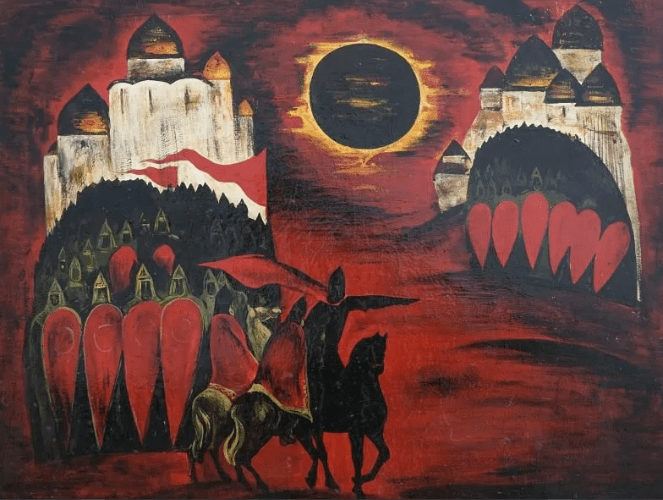
Daniil Svyatsky called the most interesting solar eclipse described in the chronicles the phenomenon of 1185. It is this event that is mentioned in “The Tale of Igor’s Campaign” and is connected with the fate of Prince Igor. The eclipse occurred during his campaign. It was perceived as a sign of trouble, and the battle ended in defeat.
Lunar eclipses are mentioned in literary monuments less often; they did not inspire such horror as solar ones. Chroniclers noted that the moon suddenly became bloody or red as copper. Such a color was associated with a war that was either going on somewhere nearby or was foreseen.
Author: Margarita Kovineva
 3. oko online - Neverovatno, ali istinito